


Joanna Bailie: At the same time (2026) Premiere – 15’
for video, four performers and electronic sounds
Eloain Lovis Hübner: World Clock [Weltzeituhr] (2026)Premiere – 20’
for six voices/performers
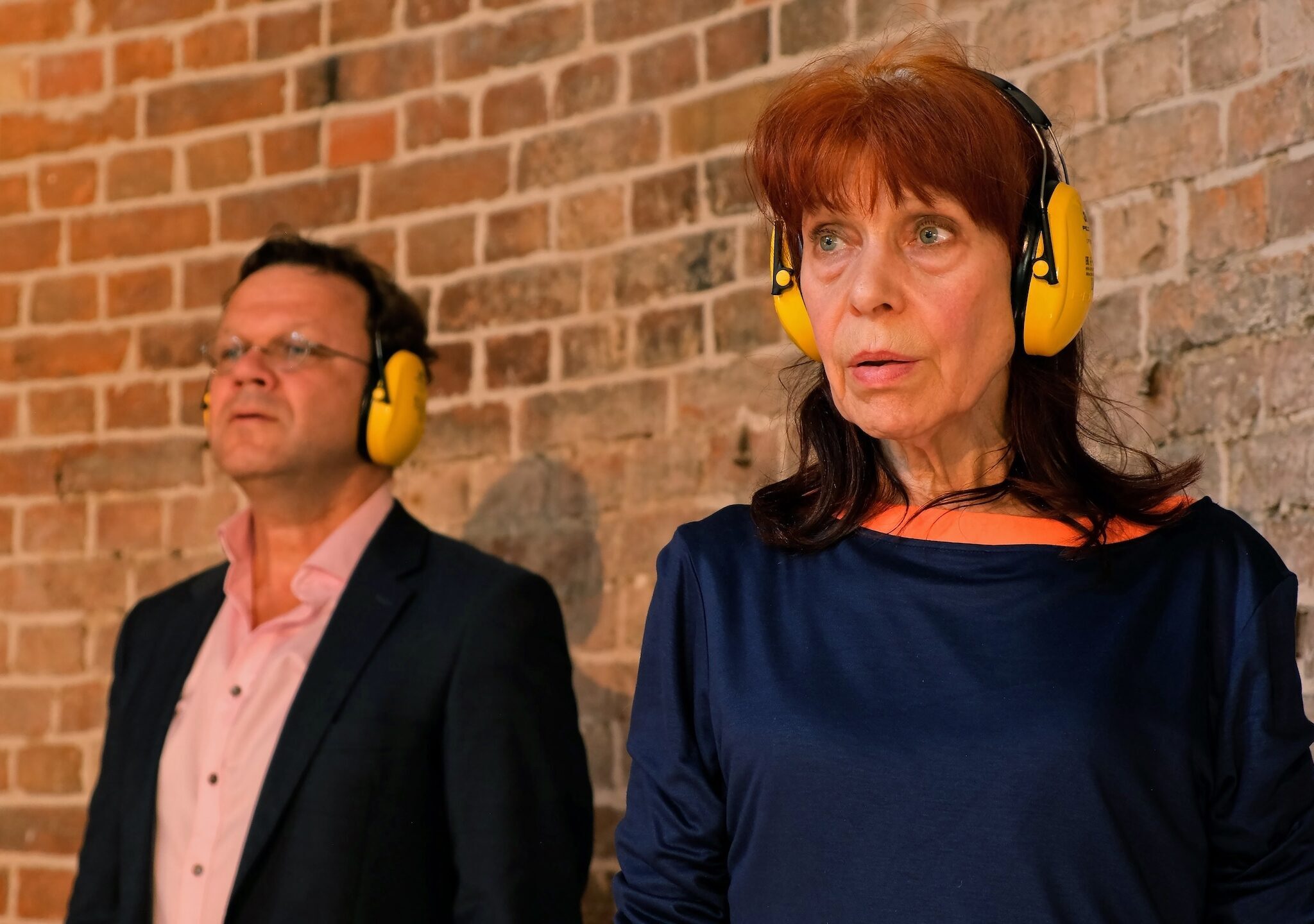
Arturas Bumšteinas: Melodies & Earmuffs (2023) – 10’
for six voices
Walter Zimmermann: Self-Forgetting [Selbstvergessen] (1982) – 20’
seven simultaneous solos for speaking and singing instrumentalists
It is completely impossible to imagine everything that is happening in the world at the very same moment—even just in Berlin, in one’s own neighborhood. A wide variety of temporalities and paces unfold in parallel within the smallest of spaces. The week is over far too quickly, yet the day just won’t seem to pass. Temporalities collide; we meet in public spaces or on the phone, planned or by chance—sometimes it works out, often it doesn’t. The four compositions this evening reflect the fleeting nature and polyphony of everyday life.
The new piece by Eloain Lovis Hübner reflects on the fleeting nature of everyday life. Within a given timeframe, each participant follows an individually prescribed structure and logic of the sequence of events. In addition to the various possibilities of the voice, there is a pool of everyday objects and media, including instruments that the participants are able (or not able) to play. Joanna Bailie’s new composition also refers to the polyphony of everyday life. Using a video of urban scenes and a stereo sound file of electronic sounds, the performers interact through movements in space, gestures, speech, and song. They attempt to embody the events, analyze them, contradict them, and extract a kind of music from them, whether acoustic or visual. In Arturas Bumšteinas’ composition, the attempt to sing folk songs together is thwarted by the isolation of the ears caused by ear muffs, leading to unintended microtonal results. Walter Zimmermann’s »Self-Forgetting« was written for Merce Cunningham’s Dance Company and parts of the text and musical notation may be omitted, “forgotten.” As a simultaneous field of mutual interpenetration, the piece remains permeable yet haunting. The Maulwerker use, among other things, selfmade instruments. Guest is cellist Tilman Kanitz.
Maulwerker, collective for vocal experiments, integrate elements of performance art, intermedial art and choreography into their music.